
A Design Space for Quantum Circuit Visualizations
Hyeok Kim & Leilani Battle
IEEE TVCG (VIS)
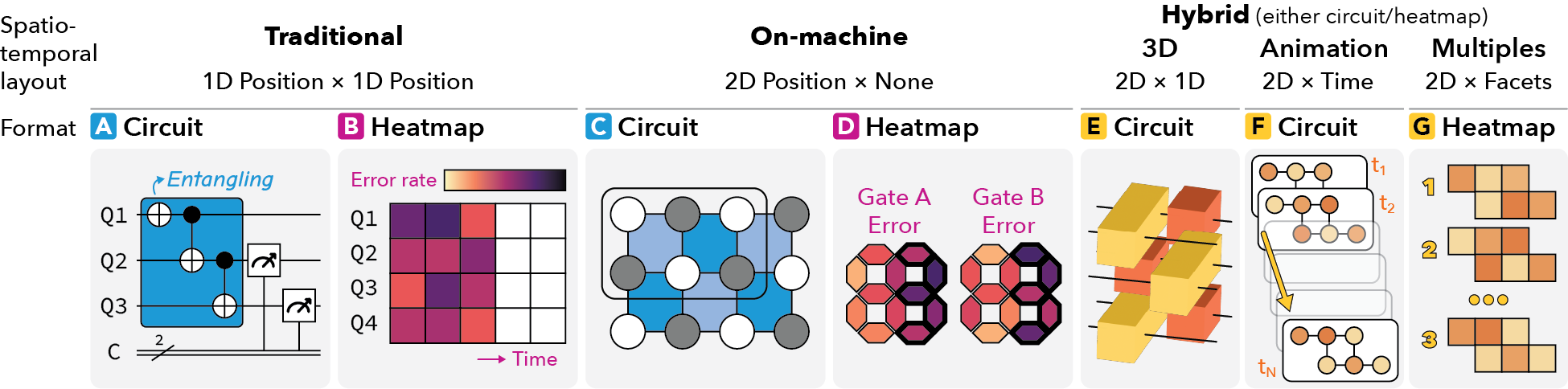
Example quantum circuit visualizations (# indicates the identifer in our corpus). (A & B) Traditional visualizations with the vertical axis for qubits and the horizontal axis for the time order of operations: (A) Traditional circuit visualization where each line represents a qubit and shapes on those lines indicate operations (#7 & #91). (B) Traditional heatmap with each cell representing the quantifed value of the corresponding qubit and time, such as error rate (#136). (C & D) On-machine visualizations where qubits are laid out on a 2-dimensional position and no time information is given. (C) On-machine circuit diagram with qubit types and groupings (#12 & #175). (D) Two concatenated on-machine heatmaps with each cell representing the quantifed variable and importance of each qubit pairing (#90). (E, F, & G) Hybrid formats that add a time dimension on an 2-dimensional on-machine layout. (E) 3-dimensional traditional circuit (#12). (F) An animated on-machine circuit (Patoka). (G) Small multiples of on- machine heatmaps where each sub-view stands for a time stamp (#105). Images are redrawn from corresponding examples in our corpus for the presentation and copyright purposes. ‘#N’ denotes the example index in our example gallery that is available via https://see-mike-out.github.io/qc-circ-gallery/. We further describe some of these examples in Section 5.
Access
Abstract
Quantum circuit visualizations play an essential role in supporting sense-making and communication of quantum programs. While several tools exist for rendering quantum circuits, they vary widely in encoding options due to idiosyncrasies among machine and platform providers. We observe an opportunity to coalesce these disparate rendering approaches under a single, unifed grammar to enable consistent, cross-platform enhancement of quantum circuit visualizations. However, it is unclear how to design such a grammar to best support the quantum computing community. Towards this end, we contribute a design space of quantum circuit visualizations by analyzing 182 static and 12 interactive cases collected from online tutorials and documentations, research publications, public presentations, and prior systems. Based on our analysis, we discuss how our design space relates to existing visualization principles yet exhibits unique aspects. We conclude with opportunities for future systems regarding data structure, cognition, and integrability.
Bibtex
@article{qc-design-space,
  title     = {A Design Space for Quantum Circuit Visualizations},
  author    = {Kim, Hyeok AND Battle, Leilani},
  journal   = {To appear in IEEE Trans. Visualization & Comp. Graphics (Proc. VIS)},
  series    = {VIS '26},
  year      = {2027}
}